
Condition score, AI summary and quick answers
Updated October 29, 20262 min read
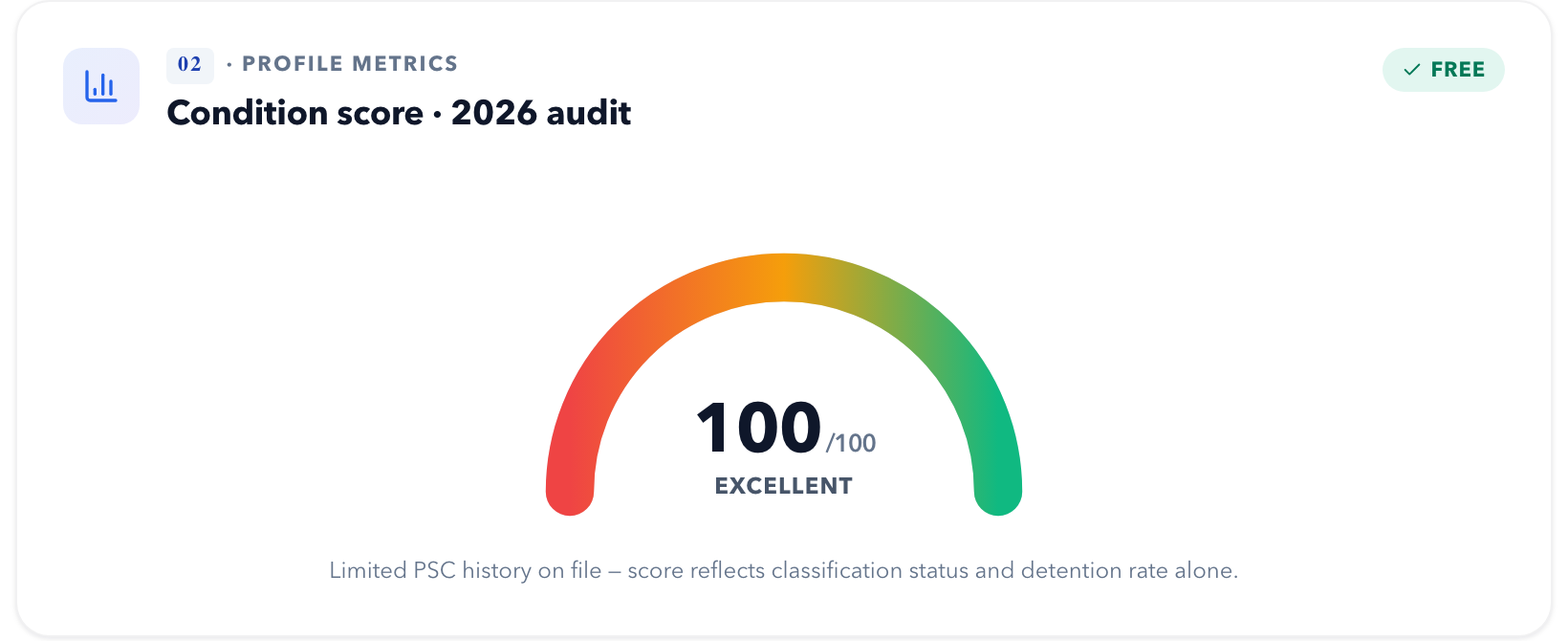
The condition score is a 0–100 gauge on the vessel page that folds class status, inspections and vessel age into one number with a label: "Excellent", "Good", "Fair", "Poor", "Very poor" or "Detention risk". The block is free and visible without signing in.
What the score is built from
The score is computed from verifiable signals, each with its own weight:
- Class status — active, suspended or withdrawn.
- Port state control detentions over the last 36 months.
- PSC deficiency rate per inspection.
- Vessel age — newer is better; the contribution declines after 20 years.
A missing signal does not drag the score down — it shrinks the ceiling instead, so a vessel with a short but clean record is not punished for thin data. When no PSC inspections are on file, the note under the gauge says the score rests on class status and age only. Age alone is not enough: with neither class nor PSC data the gauge is not shown — "insufficient data" instead of an invented number.
The score compares the vessel with fixed thresholds, not with other vessels of its type. "Detention risk" is shown only when the vessel has PSC detentions in the last 36 months; a very low score without detentions reads "Very poor".
What else gives a fast read on the vessel
- "About this vessel" at the top of the page — a short digest: what the vessel is, its class, where it has been observed, how many inspections it has passed. It is built from the same data as the rest of the page. When a language model wrote the digest, the block is titled "About this vessel · AI summary". On a phone the block shows the first four lines of the digest; the "Show more" button opens the rest.
- Quick answers — expandable answers to typical questions: type, dimensions, class society, inspection statistics, trading areas.
How to use it
The score is a first-glance filter, not a verdict. A "Fair" vessel deserves a deeper look: open the PSC inspections line by line, check the ownership chain, and verify key facts via the primary-source links at the bottom of the page.